
 The Digital Futurist
20 Local LLMs for Enterprises and Power Users: Your Guide to Unlimited AI
Four Mac Studios, two terabytes of unified memory, and zero token bills. Here is what to run as of late November 2026.
By Thomas Cherickal, Generative AI Consultant, The Digital Futurist

Introduction: Stop Renting Your Intelligence

Your AI bill doubled last quarter.
Your provider changed its usage caps again.
Your legal team will not let customer data touch a third-party API.
Your best engineer hit a rate limit in the middle of a production incident.
Most CTOs, founders and serious AI users have lived at least one of these lines this year.
I’m writing this article to tell you that you no longer have to.
Open-weight models crossed a threshold in 2026. Kimi K3.1 Pro, GLM-5.3, DeepSeek V4.1 Flash, Muse Spark Open and Mistral Large 4 now trade blows with the closed frontier, and every one of them can be downloaded today. Put the right model on the right hardware, and the token meter simply stops running.
Unlimited AI.
On your desk.
Under your control.
This guide ranks 20 open-weight models in two Top Ten lists. The first list is for enterprises running four 512 GB Mac Studios joined over Thunderbolt 5 into a 2,048 GB pool of unified memory. The second is for power users with a single machine and at least 64 GB of VRAM or unified memory.
You will get parameter counts, architectures, published benchmarks, quantized and uncensored Hugging Face releases, a full quantization primer, two detailed budgets, and the security case for running all of this yourself.
Read this article to the end to find out why.
Why Local AI Means Unlimited AI

Cloud AI is priced like electricity from a landlord. You pay per token, you accept the landlord’s rules, and the landlord can change the price whenever it likes.
Local AI turns that per-token bill into a capacity bill you own. You pay once for hardware, then a modest amount for power, and the marginal cost of the next million tokens is close to zero.
Here is what changes the day your model runs on your own silicon:
-
No per-token cost – run agents overnight, re-run evaluations a hundred times, let a coding agent burn through a million tokens on a refactor – piece of cake.
-
No rate limits – your only ceiling is the memory bandwidth of your machine.
-
No data leaving the building – prompts, documents, source code and logs stay on hardware you physically control.
-
No surprise deprecations – the weights you downloaded today will behave exactly the same in 2030.
-
Full customisation – fine-tune, distil, quantize, abliterate or merge, because the weights are yours.
-
Offline operation – an air-gapped lab, a ship at sea, a hospital during a network outage – all in a day’s work.
Is this free?
No.
Is it unlimited?
Within the throughput of your hardware, yes – and that distinction matters, which is why this guide spends so much time on memory, bandwidth and money.
The core rule of local inference is simple. Capacity decides which models fit, and bandwidth decides how fast they run. The rest of this article is that rule applied twenty times.
Understanding Quantization

You cannot talk about local AI without talking about quantization. It is the single technique that turns a 1.6 terabyte download into something that fits on a desk.
But first – what the heck is quantization anyway?
What Quantization Actually Does
Every model is a giant collection of numbers called weights. At training time each weight is usually stored in 16-bit or 32-bit floating point.
Quantization stores those same weights with fewer bits. Fewer bits per weight means less memory, less data to move per token, and therefore faster generation on bandwidth-bound hardware like Apple Silicon.
The price you pay is precision. Push the bit count too low and the model starts to forget facts, lose track of long instructions, and make sloppy tool calls.
The memory math is one line:
Add roughly 10 to 30 percent on top for the KV cache, runtime buffers and the operating system. A 70-billion-parameter model at 4.5 bits per weight needs about 39 GB for weights alone.
The Floating-Point Formats: FP32, FP16, BF16, FP8
-
FP32 – 32 bits per weight, full single precision, used for training master weights and almost never for local inference.
-
FP16 – 16 bits, half precision, with a narrow exponent range that can overflow on large activations.
-
BF16 – 16 bits with FP32’s exponent range and less mantissa precision; the default release format for most open models.
-
FP8 (E4M3 and E5M2) – 8-bit floats; E4M3 keeps more precision, E5M2 keeps more range. DeepSeek, Z.ai and Mistral now ship official FP8 checkpoints, so FP8 is effectively lossless reference quality for many 2026 models.
The New 4-Bit Floats: MXFP4 and NVFP4
-
MXFP4 – a microscaling 4-bit float from the Open Compute Project, where small blocks of 32 weights share one scale factor. Kimi K3 and Kimi K3.1 Pro ship natively in MXFP4 weights with MXFP8 activations, trained with quantization-aware training, which is why a 2.8-trillion-parameter model downloads at about 1.56 TB.
-
NVFP4 – NVIDIA’s 4-bit float for Blackwell GPUs, with smaller 16-weight blocks and an FP8 scale for better accuracy. Mistral Large 4, Muse Spark Open, Inkling and Mistral Small 4 all ship NVFP4 checkpoints.
The key difference from older 4-bit schemes is quantization-aware training. When a lab trains the model to live in 4 bits from the start, the quality loss largely disappears.
Integer Quantization: INT8 and INT4
-
INT8 – 8-bit integers with a scale per channel or per group; near-lossless for most models and widely supported on GPUs and CPUs.
-
INT4 – 4-bit integers, usually with a scale per group of 32 to 128 weights. This is the workhorse of local AI, and most GGUF, GPTQ and AWQ files are built on it.
-
W4A16 versus W4A4 – the first number is weight bits and the second is activation bits. W4A16 keeps activations in 16-bit for quality, while W4A4 squeezes both for maximum throughput on supported hardware.
GGUF Legacy Quants and K-Quants
GGUF is the file format of llama.cpp, and by extension Ollama, LM Studio and Jan. Its quant names look cryptic, but they follow a pattern.
-
Q8_0 – 8-bit, about 8.5 bits per weight, virtually indistinguishable from the original.
-
Q5_0 and Q4_0 – the original “legacy” quants: one scale per block of 32 weights, simple and fast, but less accurate than the K-quants at the same size.
-
Q6_K – about 6.6 bits per weight; the “I can’t tell the difference” tier.
-
Q5_K_M – about 5.7 bits per weight; an excellent quality-to-size trade-off for dense models.
-
Q4_K_M – about 4.8 bits per weight; the default sweet spot for most local users.
-
Q3_K_M – about 3.9 bits per weight; usable for large MoE models, noticeably weaker on small dense ones.
-
Q2_K – roughly 2.6 to 3.4 bits per weight; an emergency option to squeeze a giant model into a smaller machine.
The “K” means super-blocks with nested scales, and the S, M and L suffixes mean small, medium and large. The M and L variants keep sensitive tensors such as attention and output layers at higher precision.
I-Quants and the Importance Matrix
-
I-quants (IQ4_XS, IQ3_XXS, IQ2_XXS, IQ1_S) – lattice-based codebook quants that pack more quality into fewer bits. IQ4_XS sits near 4.25 bits per weight, IQ3_XXS near 3.06, IQ2_XXS near 2.06, and IQ1_S near 1.56.
-
The importance matrix (imatrix) – a calibration pass that runs sample text through the model and records which weights matter most. Quants built with an imatrix protect those weights, and below 4 bits the imatrix is the difference between usable and broken.
When you see “i1-GGUF” in a repository name, such as the mradermacher releases, that means imatrix-calibrated files.
Unsloth Dynamic Quants
Unsloth’s Dynamic 2.0 quants (names like UD-Q4_K_XL or UD-IQ1_S) do not give every layer the same precision. They keep critical layers at higher bit widths and crush the bulk of the MoE experts harder.
That is how Unsloth lists a 1-bit Mistral Large 4 at about 233 GB and a 1-bit Kimi K3 at about 594 GB, as reported in an M5 Ultra hosting guide. Unsloth itself claims around 91 percent top-1 agreement for its smallest Mistral Large 4 quant, which is a vendor claim, so test it on your own prompts.
GPU-Side Formats: GPTQ, AWQ, EXL3, HQQ and NF4
-
GPTQ – post-training 4-bit quantization that uses second-order information to minimise error, layer by layer; strong on NVIDIA GPUs via vLLM.
-
AWQ – activation-aware weight quantization, which protects the small fraction of weights that see the largest activations; fast and popular for vLLM and SGLang serving.
-
EXL2 and EXL3 – ExLlama’s formats with fractional bit rates such as 4.65 bpw, letting you fill a GPU to the last gigabyte.
-
HQQ – half-quadratic quantization, which needs no calibration data and quantizes very quickly.
-
bitsandbytes NF4 – the 4-bit NormalFloat format behind QLoRA fine-tuning, tuned for weights that follow a normal distribution.
MLX Quants for Apple Silicon
Apple’s MLX framework has its own group-wise quantization at 3, 4, 6 and 8 bits, published under the mlx-community organisation on Hugging Face. On Apple Silicon, MLX is often noticeably faster than llama.cpp for the same model.
One measured comparison on an M5 Ultra found DeepSeek V4 Flash at about 40 tokens per second under llama.cpp and about 53 tokens per second under MLX, according to an M5 Ultra benchmark. That is roughly a third more speed from a software switch.
KV Cache Quantization
The KV cache stores the attention keys and values for every token in your context. At a million tokens of context it can rival the weights in size.
Both llama.cpp and MLX can store the KV cache in 8-bit or 4-bit. An 8-bit KV cache is nearly free in quality and halves context memory, while 4-bit is more aggressive and worth testing on long-document tasks first.
Architecture matters here too. DeepSeek says V4.1 Flash cuts its KV cache to about a quarter of V4 Flash’s, and hybrid linear-attention designs like Qwen’s Gated DeltaNet and Kimi’s Delta Attention shrink it further.
The Quantization Cheat Sheet
| Quant | Approx. bits per weight | Memory for a 70B model | Quality loss | Best use |
|---|---|---|---|---|
| BF16 / FP16 | 16 | ~140 GB | None | Reference, fine-tuning |
| FP8 / Q8_0 | 8 – 8.5 | ~70 – 74 GB | Negligible | Enterprise serving |
| Q6_K | 6.6 | ~58 GB | Barely measurable | Quality-first local use |
| Q5_K_M | 5.7 | ~50 GB | Very small | Dense models, coding |
| Q4_K_M | 4.8 | ~42 GB | Small | Default sweet spot |
| MXFP4 / NVFP4 | 4.25 – 4.5 | ~37 – 39 GB | Small; near zero with QAT | Native 4-bit releases |
| IQ4_XS | 4.25 | ~37 GB | Small | Tight memory budgets |
| Q3_K_M | 3.9 | ~34 GB | Moderate | Large MoE models |
| IQ3_XXS | 3.06 | ~27 GB | Noticeable | Giant MoE on small machines |
| IQ2_XXS / Q2_K | 2.1 – 3.4 | ~18 – 29 GB | Significant | Emergency fits only |
| IQ1_S | 1.56 | ~14 GB | Heavy | Experiments with huge MoE |
Here is my rule of thumb.
Dense models below 40B: stay at Q5_K_M or higher.
Mid-size MoE models: Q4_K_M or MLX 4-bit.
Trillion-parameter MoE models: whatever fits, because a 2-bit giant often beats an 8-bit dwarf.
Choosing the Memory Sizes

Why 2,048 GB for enterprises?
Why a 64 GB floor for power users?
Why not more, or less?
These numbers are not arbitrary. They come straight out of the file sizes of the models that matter in late 2026.
Why 2,048 GB for the Enterprise Cluster
The new open frontier is enormous. Kimi K3.1 Pro is a 2.8-trillion-parameter model that downloads at about 1.56 TB in its native MXFP4 format, as confirmed in a Kimi K3.1 Pro weights report. Mistral Large 4 is about 1,060 GB in official FP8, and Muse Spark Open needs about 1.63 TB in full BF16.
A single 512 GB Mac Studio cannot hold any of these at high precision. Two machines (1,024 GB) hold some of them at 4-bit. Four machines (2,048 GB) hold every one of them at its native or near-native precision, with room left over.
That headroom is not waste. It goes to three jobs:
-
The KV cache – million-token contexts are now standard, and long agent sessions eat memory fast.
-
Concurrency – every extra user or agent needs its own slice of cache.
-
Multi-model serving – GLM-5.3 in FP8 (about 756 GB) and DeepSeek V4.1 Flash in FP8 (about 510 GB) fit side by side with more than 700 GB to spare, so a coding model and a general model can both stay hot.
Four is also the natural size for a Thunderbolt 5 mesh. Each Mac Studio can cable directly to the other three, so every node is one hop from every other node, and there is no switch to buy or fail.
That mesh is fast because of RDMA. Apple added RDMA over Thunderbolt 5 in macOS 26.2, and Jeff Geerling’s cluster test showed exo with RDMA speeding up as nodes were added while llama.cpp over TCP slowed down. On Qwen3 235B, exo went from 19.5 tokens per second on one node to 31.9 on four, according to AppleInsider’s write-up.
With the 2026 M5 Ultra, each node brings 1.2 TB/s of memory bandwidth. Four of them reach about 4.8 TB/s in aggregate, a figure exo Labs highlights in its four Mac cluster announcement.
Why 512 GB nodes rather than eight 256 GB nodes? TechRepublic notes that two 256 GB Mac Studios cost about $700 less than one 512 GB machine, so smaller nodes are cheaper per gigabyte. But eight nodes cannot form a direct mesh, every extra hop adds synchronisation latency, and every extra box adds cables, power bricks and failure points.
Four big nodes is the sweet spot.
Why a 64 GB Floor for Power Users
The 2026 mid-size models are astonishingly good. Qwen3.8-27B posts 61.7 on SWE-bench Pro, and its 4-bit build is only about 17 GB, according to a Qwen3.8-27B analysis.
So why not 24 GB or 32 GB? Because the floor is about running the best small models well, not just running them.
-
At 64 GB, Qwen3.8-27B or Gemma 4 31B runs at near-lossless 8-bit (around 29 to 33 GB of weights), with room for a long context window and your IDE, browser and agent tools.
-
At 64 GB, every MoE model up to the 35B class runs at 8-bit, and Nemotron 3.5 Bolt runs with an enormous context budget.
-
At 128 GB, you add the 100B-class MoE models: gpt-oss-120b (about 65 GB native), Mistral Small 4 and Qwen3.5-122B-A10B at 4-bit.
-
At 256 GB, you add DeepSeek V4 Flash at 4-bit (about 151 to 162 GB).
| Memory tier | What runs comfortably | Typical hardware |
|---|---|---|
| 64 GB | Qwen3.8-27B (Q8), Gemma 4 31B (Q8), Qwen3.6-35B-A3B (Q8), Muse Glimmer 30B (Q8), Inkling 2 Mini (NVFP4), Nemotron 3.5 Bolt | Ryzen AI Max+ 395 64 GB, 64 GB DGX Spark partner units, M5 Max Mac Studio 64 GB |
| 128 GB | All of the above plus gpt-oss-120b, Mistral Small 4 (Q4), Qwen3.5-122B-A10B (Q4) | Ryzen AI Max+ 395 128 GB, DGX Spark 128 GB, M5 Max Mac Studio 128 GB |
| 256 GB+ | All of the above plus DeepSeek V4 Flash (4-bit) | M5 Ultra Mac Studio 256 GB or 512 GB, 2x RTX PRO 6000 workstation |
Sixty-four is the floor.
One hundred and twenty-eight is the sweet spot.
Two hundred and fifty-six is the dream.
Top 10 Local LLMs for Enterprises

Hardware: four Mac Studios with M5 Ultra and 512 GB of unified memory each, cabled as a Thunderbolt 5 mesh with RDMA enabled, for 2,048 GB of pooled memory and about 4.8 TB/s of aggregate bandwidth.
Ranking rule: most powerful in real-world usability first. I weigh output quality, agentic and tool-calling reliability, speed on this cluster, licence freedom and context length – not raw benchmark scores alone.
A word on benchmarks: almost every number below is vendor-reported, and labs use different harnesses. Treat cross-lab comparisons as directional, not as gospel.
1Kimi K3.1 Pro

Moonshot AI’s Kimi K3.1 Pro is the most capable open-weight model you can download as of late November 2026. It is also the model that justifies the entire 2,048 GB cluster.
-
Developer and release: Moonshot AI; API launch on 23 October 2026, with weights published on Hugging Face in early November as
moonshotai/Kimi-K3.1-Pro. -
Parameters: 2.8 trillion total, 104 billion active per token.
-
Architecture: Mixture-of-Experts built on Kimi K3, with 896 experts (16 routed plus 2 shared per token), Kimi Delta Attention layers interleaved with Gated MLA layers, and Attention Residuals, as described in the Kimi K3 release coverage. Native MXFP4 weights with MXFP8 activations, trained quantization-aware.
-
Context and modality: about 1 million tokens; text and image input.
-
Licence: Kimi K3.1-Pro License, a modified MIT. Internal use is free; products above 100 million monthly users or $20 million monthly revenue must display the model name, and model-as-a-service businesses above $20 million trailing revenue need a separate agreement.
-
Benchmarks: 65.7 percent on Terminal-Bench 4.0 and 51.7 percent on SWE Marathon v1.1 per Moonshot’s own table, as summarised in a November open-weight roundup. It also tops the GPQA Diamond ranking at 94.2 percent on LLM Reference’s leaderboard.
-
Local performance: a cluster of four 512 GB Mac Studios running a quantized build of its predecessor Kimi K3 (about 817 GB on disk) measured about 238 tokens per second of prompt processing and about 14.7 tokens per second of generation, per a Kimi K3 cluster guide. The guide does not say which Mac Studio chip was used. Expect K3.1 Pro, with the same architecture and size, to land in a similar range.
-
Best use-cases: long-horizon agentic coding, multi-step research agents, financial analysis, multimodal document work, and anything where you want the strongest open model available.
-
Recommended release: the official MXFP4 repository,
moonshotai/Kimi-K3.1-Pro(96 shards, about 1.56 TB). It is already 4-bit, so there is little reason to re-quantize on this cluster. -
Uncensored variant: none that I can recommend as of this writing. No trustworthy abliterated release of the 2.8T K3.1 Pro has been published, and abliterating a model this size is a serious engineering job in its own right.
-
Cluster fit: about 1.56 TB of weights, leaving roughly 450 to 490 GB for the KV cache, macOS and buffers. Plan for a small team of concurrent users rather than a whole company, because single-stream generation sits in the mid-teens of tokens per second.
Why rank 1: nothing else open-weight matches its combination of agentic depth, million-token context and multimodal input. It is the slowest model on this list – and the smartest.
2GLM-5.3

Z.ai’s GLM-5.3 is the coding and cybersecurity specialist of the open frontier. If your enterprise writes software, this is the model your engineers will fight over.
Its successor, GLM-5.4, arrived on 23 November as Z.ai’s first Loop Transformer, running 28 layers of the GLM-5 base twice at about 750B parameters. It is hosted-only for now, Z.ai has published no benchmark scores for it, and weights will follow safety hardening, per The Next Web. Until they ship, GLM-5.3 is the GLM you can own.
-
Developer and release: Z.ai (Zhipu AI); API on 14 August 2026, open weights on 28 August 2026 (29 August in Japan), as reported by GIGAZINE’s release note.
-
Parameters: 753B total on the model card, built on the same base model as GLM-5.2, which LLM Reference lists with 40B active.
-
Architecture: sparse MoE with indexed sparse attention and a multi-token prediction layer for speculative decoding; all gains over GLM-5.2 came from post-training.
-
Context: 1 million tokens.
-
Licence: GLM-5.3 License. The only extra condition is a Z.ai security review for model-as-a-service providers earning over $10 billion a year, so for nearly every enterprise it behaves like MIT.
-
Benchmarks: from the GLM-5.3 model card: 88.2 on Terminal Bench 2.1, 84.5 on CyberGym, 73.0 on Toolathlon Verified, 62.5 on HLE with tools, and a 50 percent gain over GLM-5.2 on Z.ai’s in-house Code Bench.
-
Local performance: GLM-5.2 at 4-bit measured about 213.6 tokens per second prefill and 17.7 tokens per second generation on a single M3 Ultra; the M5 Ultra’s roughly 46 percent higher bandwidth should lift that meaningfully.
-
Best use-cases: agentic software engineering, code review at scale, vulnerability discovery and secure-code auditing, terminal automation.
-
Recommended release: official FP8 weights (about 756 GB) from
zai-org/GLM-5.3for full quality, or Unsloth’sUD-Q5_K_XLGGUF (about 562.5 GB) if you want to share the cluster with a second model. -
Uncensored variant: none for GLM-5.3 yet. For the previous generation there is the gated
0xdfi/GLM-5.2-QuantTrio-Abliterated. -
Cluster fit: FP8 uses about 37 percent of the pool, which leaves enough room to run DeepSeek V4.1 Flash alongside it.
Why rank 2: on coding and terminal work it sits right next to the closed frontier, it runs faster than Kimi because only 40B parameters are active, and its licence is practically unrestricted.
3DeepSeek V4.1 Flash-1017

DeepSeek did something unusual in September 2026. It released a “Flash” model and then retired its own flagship because the Flash model beat it.
-
Developer and release: DeepSeek; V4.1 Flash launched on 10 September 2026, and the 1017 weight update followed on 17 October 2026, as covered by TechNode’s 1017 report.
-
Parameters: a 552B-parameter MoE backbone plus 196B of Engram n-gram memory, with only 8B active per prompt token and 16B per output token.
-
Architecture: a 40-layer Causal Encoder-Decoder (20-layer encoder, 20-layer decoder), sliding-window plus compressed sparse attention, hyper-connections and native vision, per the vLLM deployment recipe. DeepSeek says its KV cache needs about a quarter of the HBM of the previous generation.
-
Context: 1 million tokens of input, up to 384K tokens of output.
-
Licence: MIT, for the code and the weights.
-
Benchmarks: DeepSeek reports 90.6 on Terminal-Bench 2.1 for the launch build and 77.0 on DeepSWE v1.1 for the 1017 update, up from 74.2. Its GPQA Diamond score of 93.18 percent is second only to Kimi K3.1 Pro on LLM Reference.
-
Local performance: no published Mac cluster numbers yet. With only 16B parameters active per output token, it should be the fastest frontier-class model in this list on the cluster.
-
Best use-cases: high-volume agent fleets, coding agents, document and screenshot understanding, and any workload where cost per task matters more than peak intelligence.
-
Recommended release:
deepseek-ai/DeepSeek-V4.1-Flash-1017in FP8, about 510 GB. Note that it ships without a Jinja chat template, so use DeepSeek’s own encoding script or a runtime that supports it. -
Uncensored variant: abliterated forks of V4.1 Flash appeared on Hugging Face within hours of launch, according to Tech Insider’s coverage. Vet any such repository carefully before use; see the provenance checklist later in this article.
-
Cluster fit: about 25 percent of the pool, so this is your high-concurrency workhorse.
Why rank 3: MIT licence, million-token context, vision, and near-frontier agentic scores at a fraction of the active compute. It is the model that serves the most people per watt.
4Inkling 2 Small

Inkling 2 Small is the newest model on this list, and it replaces Inkling-Small outright. Thinking Machines built it as a base for agents that plan, call tools and check their own results – chat quality came second.
-
Developer and release: Thinking Machines Lab; announced 5 November 2026 on its Tinker platform, with weights on Hugging Face from 12 November, per the Inkling 2 Small announcement.
-
Parameters: 594B total, 17B active (about 2.9 percent active), per Raschka’s architecture gallery.
-
Architecture: multimodal sparse MoE with a 48-layer decoder, 8 of 384 experts routed per token, block attention residuals and a multi-token prediction block; pretrained and RL-trained natively in NVFP4.
-
Context and modality: up to 1 million tokens; text and image input through a 292M-parameter vision encoder, text output, and variable reasoning effort.
-
Licence: Apache 2.0 on the Hugging Face model card, as confirmed by RuneLab’s release explainer.
-
Benchmarks: Thinking Machines reports 72.1 on DeepSWE v1.1, 86.3 on SWE-Bench Pro v2 (Hard), 90.2 on BrowseComp, 85.4 on MCP Atlas, 81.7 on ARC-AGI v2 and 81.6 on MMMU Pro. These are vendor numbers, so treat them as a ceiling until independent runs arrive.
-
Local performance: no published Mac cluster numbers yet. With only 17B active parameters, it should generate far faster than the 40B-plus-active giants ranked around it.
-
Best use-cases: agentic coding, tool-heavy research agents, browsing and retrieval, screen and document understanding, and fine-tuning a private agent on your own data.
-
Recommended release: the official NVFP4 checkpoint
thinkingmachines/Inkling-2-Small(about 394 GB) orthinkingmachines/Inkling-2-Small-MXFP8(about 623 GB) for vLLM and SGLang. For llama.cpp, Unsloth’sunsloth/Inkling-2-Small-GGUFQ8_0 build keeps the NVFP4 experts at about 387 GB, and bartowski’s Q4_K_M is about 369 GB, per VDF’s hardware guide. -
Uncensored variant: none published that I can verify; it scores 97.1 on StrongREJECT.
-
Cluster fit: under a fifth of the pool at Q8_0, or under a third with the MXFP8 checkpoint, so it sits comfortably beside GLM-5.3 or DeepSeek V4.1 Flash.
Why rank 4: Apache 2.0 weights, a million-token context, vision and agentic scores just behind DeepSeek V4.1 Flash – all at 17B active. It is the strongest permissively licensed agent model on this list.
5Qwen3.8-2.4T-A95B

Alibaba’s Qwen3.8-2.4T-A95B is the open-weight release of Qwen3.8-Max, and the first time Qwen has opened a Max-tier model.
-
Developer and release: Alibaba’s Qwen team; weights published on 13 August 2026, per the Qwen3.8 flagship report.
-
Parameters: 2.4 trillion total, 95 billion active.
-
Architecture: hybrid Gated DeltaNet linear attention with gated full attention, inherited from the Qwen3.5 lineage.
-
Context and modality: 262,144 tokens native, extendable to about 1 million; the open checkpoint is text-only, while the hosted Qwen3.8-Max adds vision.
-
Licence: Qwen3.8-Max License, a modified MIT with a display clause, plus a separate licence for model-as-a-service or AI work-assistant businesses above $50 million a year.
-
Benchmarks: 82.0 on Terminal-Bench 2.1, as quoted in Meta’s comparison table, and second place among open-weight models on the Artificial Analysis index at release, according to The Batch.
-
Local performance: no published Mac cluster figures yet; with 95B active parameters, expect speeds similar to Kimi K3.1 Pro.
-
Best use-cases: text-heavy enterprise knowledge work, multilingual analysis across Qwen’s very wide language coverage, long-form reasoning.
-
Recommended release: the full checkpoint is about 4.9 TB, which does not fit. A 4-bit GGUF or MLX build lands around 1.3 TB, which does.
-
Uncensored variant: none published that I can verify.
-
Cluster fit: about 1.3 TB at 4-bit, leaving roughly 700 GB of headroom.
Why rank 5: enormous knowledge capacity and strong reasoning, held back from a higher rank only by the text-only open checkpoint and the need to quantize it.
6Mistral Large 4

Mistral Large 4, nicknamed “Le Chonk”, is Europe’s trillion-parameter answer, trained from scratch on Mistral’s own European infrastructure.
-
Developer and release: Mistral AI; API preview on 6 October 2026, open weights on 29 October 2026 as
mistralai/Mistral-Large-4-1T-A52B. -
Parameters: about 1.05 trillion total, 49 billion active (52 billion including embeddings).
-
Architecture: natively multimodal MoE with 128 routed experts, 4 active plus 1 shared per token, in a 72-layer decoder.
-
Context and languages: 1 million tokens; more than 160 languages, including every official EU language.
-
Licence: Mistral Ecosystem Open-Weight License, a modified MIT. Commercial use is allowed, but any model-as-a-service business needs a separate commercial licence, with no revenue threshold.
-
Benchmarks: 41 percent on Terminal-Bench 4.0, up 13 points from the preview, per AI TL;DR’s release note. Mistral also reports a 96.6 percent refusal rate on malicious cyber prompts, which matters for the security section later.
-
Local performance: a Q2_K build on a single 512 GB M3 Ultra reached about 15 tokens per second of generation and about 90 tokens per second of prefill, per this hardware guide.
-
Best use-cases: EU-regulated industries, multilingual customer and legal work, enterprises that want a European supply chain for their AI.
-
Recommended release: official FP8 (about 1,060 GB) for full quality on the cluster, or
ggml-org/Mistral-Large-4-1T-A52B-GGUFat Q4_K_M (about 500 GB) to free memory for a second model. -
Uncensored variant: none yet; given the very high built-in refusal rate, expect abliteration to take serious effort.
-
Cluster fit: FP8 uses about half the pool.
Why rank 6: a trillion-parameter model with a clean commercial licence for in-house use and the strongest sovereignty story in this list for European buyers.
7Muse Spark Open

Meta’s Muse Spark Open is the most capable US open-weight model to date, and it was built with the Mac Studio in mind.
-
Developer and release: Meta Superintelligence Labs; weights released on 15 October 2026, with MLX optimisation developed alongside Apple, per Meta’s announcement.
-
Parameters: 816B total, about 42B active.
-
Architecture: natively multimodal MoE, with official checkpoints
Muse-Spark-Open-816B-A42B(BF16) andMuse-Spark-Open-816B-A42B-NVFP4. -
Context: 1 million tokens.
-
Licence: Muse Model License, with limited commercial terms and a requirement to prominently display “Built with Muse Spark Open” in any product that uses it, as The New Stack reports. Read it carefully before you build a product.
-
Benchmarks: from Meta’s table as reported by Let’s Data Science: 89.2 on MCP-Atlas tool use and 61.8 on JobBench, both ahead of Kimi K3, GLM-5.3 and Qwen3.8; but 76.4 on Terminal-Bench 2.1, behind all three, and 60 on DeepSWE 1.1, behind Kimi K3 and GLM-5.3.
-
Local performance: Apple’s own measurement put the 4-bit NVFP4 checkpoint (about 493 GB) at 36.73 tokens per second on four M5 Ultra Mac Studios, with the model split by width at an 8,192-token context and two Thunderbolt cables per link, against 15.74 for two machines in a pipeline, per MIXED’s report. That is the best published four-node number in this article.
-
Best use-cases: tool-heavy agents, MCP workflows, office and job-style tasks, multimodal assistants.
-
Recommended release: the official
Muse-Spark-Open-816B-A42B-NVFP4checkpoint that Apple benchmarked (about 493 GB). With four nodes you can also run an 8-bit build (Unsloth lists about 900 GB needed) or full BF16 (about 1.63 TB). The Unsloth Muse guide documents theunsloth/Muse-Spark-Open-816B-A42B-GGUFladder. -
Uncensored variant: none; Meta added extra safety post-training because the weights are public.
-
Cluster fit: NVFP4 uses about a quarter of the pool; even 8-bit leaves more than 1 TB free for context and a second model.
Why rank 7: the fastest measured giant on this exact hardware and the best tool-user in the list, held back by its licence and by trailing the top three on hard coding.
8Inkling

Thinking Machines Lab, founded by former OpenAI CTO Mira Murati, released Inkling as a broad, balanced base for enterprises to shape themselves.
-
Developer and release: Thinking Machines Lab; released 15 July 2026.
-
Parameters: 975B total, 41B active.
-
Architecture: sparse MoE with 66 layers, 256 routed experts and 2 shared experts, 6 experts per token, sliding-window and global attention at a 5:1 ratio, and learned relative positional embeddings instead of RoPE, per Analytics Vidhya’s guide.
-
Context and modality: 1 million tokens; text, image and audio input, text output.
-
Licence: Apache 2.0 – the most permissive licence among the trillion-class models.
-
Benchmarks: Thinking Machines is candid that Inkling is not the strongest model overall. Its headline is efficiency: on Terminal Bench 2.1 it reaches the same coding performance as NVIDIA’s Nemotron 3 Ultra with one-third of the tokens, per DataCamp’s overview.
-
Local performance: no published Mac cluster numbers yet.
-
Best use-cases: fine-tuning a private enterprise model on your own data, audio and document workflows, high-volume agents where token efficiency drives cost.
-
Recommended release: BF16 is about 1.95 TB, which would fill the cluster. Use an 8-bit GGUF (roughly 1 TB) for full-quality inference and keep BF16 for fine-tuning elsewhere.
-
Uncensored variant: none; it scores 98.6 percent on the StrongREJECT refusal test.
-
Cluster fit: about half the pool at 8-bit.
Why rank 8: Apache 2.0, audio input and a design built for customisation make it the deepest foundation for a proprietary in-house model, though the newer Inkling 2 Small is the better pick if you do not need audio.
9MiniMax M3

MiniMax M3 is the long-context efficiency specialist of the group.
-
Developer and release: MiniMax; API launch on 1 June 2026 and Hugging Face weights from 2 June, per SemiAnalysis InferenceX.
-
Parameters: about 428B total, 23B active.
-
Architecture: native multimodal MoE trained on text, image and video from the first step, with MiniMax Sparse Attention (MSA) for million-token contexts.
-
Context: 1 million tokens.
-
Licence: MiniMax Community License; read the terms before commercial deployment.
-
Benchmarks: MiniMax reports 9x faster prefill and 15x faster decode than M2 at 1M context, cutting per-token compute to one-twentieth, per the MiniMax M3 card. It scores 90.91 percent on GPQA Diamond on LLM Reference.
-
Local performance: an MLX 4-bit build is about 240 GB; no published cluster numbers yet.
-
Best use-cases: whole-codebase and whole-archive analysis, video and document understanding, long-running agents that keep huge contexts.
-
Recommended release: 8-bit on the cluster (about 460 to 470 GB) or the MLX 4-bit build if you want it to fit in one node.
-
Uncensored variant: none published that I can verify.
-
Cluster fit: at 8-bit it uses under a quarter of the pool, so it pairs well with a frontier model.
Why rank 9: the most efficient million-token model here, small enough to run on a single node at 4-bit.
10Qwen3.8-Flash-Next

Qwen3.8-Flash-Next is Alibaba’s early preview of the Qwen4 architecture, and it is brutally efficient.
-
Developer and release: Alibaba’s Qwen team; released 26 August 2026, per DataCamp’s Flash-Next breakdown.
-
Parameters: a 125B main model plus 51B of n-gram embeddings (176B total), with only 6B active per token and a further 4B in the multi-token prediction head.
-
Architecture: Gated DeltaNet plus Qwen Sparse Attention, Gated Residual connections, n-gram embeddings, trained with the Muon optimizer.
-
Context and modality: 262,144 tokens native, extendable to 1 million; text, image and video.
-
Licence: qwen-community-1.0, which The Next Web notes may not qualify for the EU AI Act’s open-source exemption.
-
Benchmarks: DataCamp reports it beats Claude Opus 4.6 (Max) on most of Qwen’s coding and agent benchmarks; it scores 91.7 percent on GPQA Diamond on LLM Reference.
-
Local performance: about 352 GB in BF16 and roughly half that in FP8; with 6B active, it should be the fastest model on the cluster by a wide margin.
-
Best use-cases: the high-concurrency front door for the whole organisation – chat, triage, classification, routing requests to the bigger models.
-
Recommended release: the official BF16 checkpoint
Qwen/Qwen3.8-Flash-Next, or the official FP8 checkpointQwen/Qwen3.8-Flash-Next-FP8. -
Uncensored variant: none published that I can verify.
-
Cluster fit: a few percent of the pool; run several instances.
Why rank 10: it does not compete with the giants on depth, but it lets one cluster serve hundreds of quick requests while the giants think.
Honourable mentions: Inkling-Small (276B, 12B active, about 552 GB in BF16), now superseded by Inkling 2 Small but still a light fine-tuning base, per the Inkling-Small model card; GLM-5.4 (about 750B), which is live on Z.ai’s Coding Plan but has no open weights yet; GLM-5.3-Flash (320B, 18B active), NVIDIA Nemotron 3.5 Super VL (120B, 12B active), and Meituan’s LongCat-2.5 (1.6T, about 48B active, MIT), whose model card currently documents deployment only on NPUs.
Top 10 Local LLMs for Power Users

Hardware: one system with at least 64 GB of VRAM or unified memory. Think Ryzen AI Max+ 395 mini PCs, NVIDIA DGX Spark, M5 Max or M5 Ultra Mac Studios, or a workstation with an RTX PRO 6000.
Ranking rule: usability first. For a single machine that means quality per gigabyte, speed, tool-calling reliability, licence freedom, and the availability of good quantized and uncensored builds.
Memory tier notes: each entry lists the smallest tier that runs it comfortably, so you can see at a glance what your own machine can handle.
1Qwen3.8-27B

The best local model you can run on a single consumer machine in late 2026 is a 27-billion-parameter dense model.
-
Developer and release: Alibaba’s Qwen team; released 14 August 2026 under Apache 2.0 as
Qwen/Qwen3.8-27B. -
Parameters: 27B dense, with a vision encoder for images and video.
-
Architecture: 64 layers in a 16 x (3 Gated DeltaNet + 1 Gated Attention) layout, so only 16 layers use full softmax attention; multi-token prediction for speculative decoding. Details are on the Qwen3.8-27B card.
-
Context: 262,144 tokens native, extendable to 1 million.
-
Licence: Apache 2.0.
-
Benchmarks: 61.7 on SWE-bench Pro, ahead of Claude Opus 4.6 Max’s 53.4; 73.0 on Terminal Bench 2.1; 84.3 on OSWorld-Verified; 42.3 on NL2Repo-Bench.
-
Local performance: the 4-bit build is about 17 GB and the MLX 4-bit build about 16.1 GB, so it runs fast even on modest machines; at 8-bit it is about 29 GB.
-
Best use-cases: agentic coding, computer-use agents, document and screenshot understanding, daily driver for everything.
-
Memory tier: 64 GB (8-bit with long context).
-
Recommended quant: Q8_0 or MLX 8-bit on 64 GB machines; Q6_K if you want a bigger context window.
-
Uncensored variant: Huihui’s abliterated GGUF (
huihui-ai/Huihui-Qwen3.8-27B-abliterated-GGUF), plus alternatives such asheretic-org/Qwen3.8-27B-heretic-ara.
Why rank 1: frontier-class agentic scores, Apache 2.0, a tiny memory footprint, and some of the most downloaded abliterated releases on Hugging Face.
2DeepSeek V4 Flash

DeepSeek V4 Flash has been retired from DeepSeek’s API in favour of V4.1 Flash, but its MIT-licensed weights remain one of the best things a single large-memory machine can run.
-
Developer and release: DeepSeek; released 24 April 2026 alongside V4-Pro, per DeepSeek’s V4 announcement.
-
Parameters: 284B total, 13B active.
-
Architecture: MoE trained with the Muon optimizer and FP4 plus FP8 mixed precision; weights stored in FP4 and FP8.
-
Context: 1 million input tokens, up to 384K output.
-
Licence: MIT.
-
Benchmarks: DeepSeek says Flash reasoning closely approaches V4-Pro and matches it on simple agent tasks; see the published chart below.
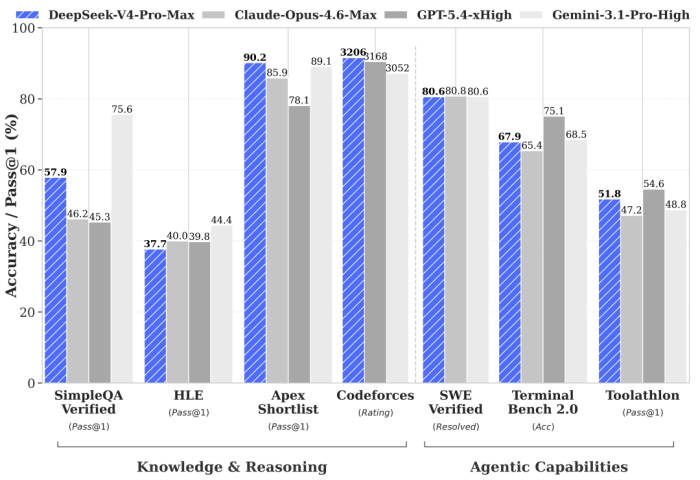
Chart: DeepSeek V4 benchmark results, published by DeepSeek at api-docs.deepseek.com.
-
Local performance: about 53 tokens per second under MLX and 40 under llama.cpp on an M5 Ultra.
-
Best use-cases: a single-machine frontier experience, long-document work, coding agents.
-
Memory tier: 256 GB for 4-bit (MLX 4-bit about 151 GB); 128 GB is possible with Unsloth’s 2-bit build (about 102 GB) at a quality cost.
-
Recommended quant: MLX 4-bit on an M5 Ultra; Unsloth
UD-Q4_K_XLon a dual RTX PRO 6000 workstation. -
Uncensored variant:
huihui-ai/Huihui-DeepSeek-V4-Flash-0731-abliterated-GGUF, and Fraser Price’s vLLM port (fraserprice/DeepSeek-V4-Flash-Abliterated), which its author describes as keeping tool-calling intact on two RTX PRO 6000 cards.
Why rank 2: the strongest MIT-licensed model a single machine can hold at 4-bit. It only drops below Qwen3.8-27B because it needs four to eight times the memory.
3Inkling 2 Mini

Inkling 2 Mini is the smallest model in Thinking Machines’ second generation, and it brings a new idea to the desktop: a looped transformer.
-
Developer and release: Thinking Machines Lab; released with open weights on Hugging Face on 20 November 2026, per MarkTechPost’s launch report.
-
Parameters: 26.4B total and 3.4B active; because the looped layers run three times, it uses about 5.4B effective active parameters per token.
-
Architecture: a 24-layer sparse MoE that routes each token to 8 of 128 experts, with the middle 12 layers run three times per token on shared weights, giving 48 layer applications from 24 layers of weights. Most weights were trained natively in NVFP4.
-
Context and modality: 1 million tokens; text and image input, text output.
-
Licence: Apache 2.0.
-
Benchmarks: 79.2 percent on SWE-bench Verified, and 20 on the Artificial Analysis Intelligence Index, which matches Qwen3.8-27B at its highest effort setting, per Artificial Analysis. The catch: it averages about 152K output tokens per Intelligence Index task, so it thinks long.
-
Local performance: the checkpoint is about 20 GB, small enough for a 32 GB Mac or a single DGX Spark; no published tokens-per-second figures yet.
-
Best use-cases: local agentic coding, tool use, document and screenshot work, and always-on agents on laptops.
-
Memory tier: 32 GB to run, 64 GB to run with a long context.
-
Recommended quant: the official native NVFP4 checkpoint (about 20 GB); there is little to gain from requantizing weights that were trained in 4-bit.
-
Uncensored variant: none published that I can verify.
Why rank 3: the most agentic capability per gigabyte on this list, with Apache 2.0 weights and a million-token context. It sits behind Qwen3.8-27B, which matches it on the Intelligence Index with a more mature uncensored ecosystem, and behind DeepSeek V4 Flash on raw depth.
4Gemma 4 31B

Google DeepMind’s Gemma 4 31B is the strongest Western dense model you can run on a laptop-class machine.
-
Developer and release: Google DeepMind; released 2 April 2026.
-
Parameters: 30.7B dense.
-
Architecture: hybrid attention that interleaves local sliding-window and global layers, with unified keys and values and Proportional RoPE in global layers for long context, per the Gemma 4 model card.
-
Context and modality: 256K tokens; text and image input, video as frames; more than 140 languages in pre-training.
-
Licence: Apache 2.0.
-
Benchmarks: 89.2 percent on AIME 2026 without tools, 80.0 percent on LiveCodeBench v6, a Codeforces Elo of 2150, 84.3 percent on GPQA Diamond and 76.9 percent on Tau2.
-
Local performance: at Q4_K_M, the uncensored Heretic build is about 17 GB; at 8-bit, about 33 GB.
-
Best use-cases: maths and competitive programming, multilingual chat, vision and OCR, native function calling.
-
Memory tier: 64 GB.
-
Recommended quant: Q8_0 or MLX 8-bit on 64 GB; Google also publishes QAT checkpoints that hold up well at Q4_0.
-
Uncensored variant: the Gemma 4 abliterated collection from huihui-ai, including
huihui-ai/Huihui-gemma-4-31B-it-abliteratedand QAT-based GGUFs, plusStabhappy/gemma-4-31B-it-heretic-Gguf.
Why rank 4: outstanding reasoning per gigabyte and a mature uncensored ecosystem, but weaker than Qwen on agentic software engineering, scoring 52.0 on SWE-bench Verified in Qwen’s comparison table.
5gpt-oss-120b

OpenAI’s gpt-oss-120b is more than a year old, and it is still on this list. That tells you how well it was built.
-
Developer and release: OpenAI; released August 2025.
-
Parameters: 117B total, about 5.1B active.
-
Architecture: MoE with native MXFP4 expert weights and configurable reasoning effort.
-
Context: 131,072 tokens.
-
Licence: Apache 2.0.
-
Benchmarks: Mistral and others still use it as the reference point for this size class; Mistral reports Small 4 matching or beating it on three benchmarks with shorter outputs.
-
Local performance: about 65 GB in native MXFP4; the Unsloth GGUF repo also offers Q4_K_M at about 62.7 GB.
-
Best use-cases: reliable tool use, structured outputs, general reasoning in English.
-
Memory tier: 128 GB (it needs slightly more than 64 GB).
-
Recommended quant: the native MXFP4 release; re-quantizing it gains almost nothing.
-
Uncensored variant: several.
kldzj/gpt-oss-120b-heretic(packaged for Ollama as gpt-oss heretic 120b),ArliAI/gpt-oss-120b-Derestricted, and huihui-ai’s abliterated Ollama builds.
Why rank 5: rock-solid tool calling and the most battle-tested uncensored variants in the list, held back by a shorter context window and its age.
6Mistral Small 4

Mistral Small 4 is three models in one: Magistral reasoning, Pixtral vision and Devstral coding, merged into a single MoE.
-
Developer and release: Mistral AI; released 16 March 2026 as
mistralai/Mistral-Small-4-119B-2603. -
Parameters: 119B total, 6.5B active.
-
Architecture: MoE with 128 experts, 4 active per token, MLA attention, and an Eagle head for speculative decoding.
-
Context and modality: 256K tokens; text and image input.
-
Licence: Apache 2.0.
-
Benchmarks: Mistral says it matches or surpasses gpt-oss-120b on its three headline benchmarks, scores 0.72 on AA LCR with 1.6K characters of output where Qwen models need 3.5 to 4 times more, and beats gpt-oss-120b on LiveCodeBench with 20 percent less output, per the Mistral Small 4 launch.
-
Local performance: a Q4_K_M build is roughly 70 GB; with only 6.5B active, generation is fast.
-
Best use-cases: one model for chat, reasoning, coding and document vision; European data-residency projects; concise answers that save context.
-
Memory tier: 128 GB.
-
Recommended quant:
unsloth/Mistral-Small-4-119B-2603dynamic GGUFs orbatiai/Mistral-Small-4-119B-GGUFat Q4_K_M. -
Uncensored variant:
darkc0de/Mistral-Small-4-119B-2603-heretic, also available as a Heretic NVFP4 build for Blackwell GPUs.
Why rank 6: the most versatile single model at this size, with a configurable reasoning effort that keeps answers short when you want speed.
7Qwen3.6-35B-A3B

Three billion active parameters should not be able to do this.
-
Developer and release: Alibaba’s Qwen team; released in April 2026 as the first open-weight Qwen3.6 model.
-
Parameters: 35B total, 3B active.
-
Architecture: 10 x (3 Gated DeltaNet + 1 Gated Attention) blocks with MoE feed-forward layers; 256 experts with 8 routed plus 1 shared active.
-
Context and modality: long context with multimodal thinking and non-thinking modes, and “thinking preservation” that keeps reasoning across agent turns.
-
Licence: Apache 2.0.
-
Benchmarks: from the Qwen3.6-35B-A3B blog: 73.4 on SWE-bench Verified, 49.5 on SWE-bench Pro, 51.5 on Terminal-Bench 2.0, 86.0 on GPQA and 85.2 on MMLU-Pro.
-
Local performance: with 3B active it is extremely fast on any hardware; 8-bit is roughly 37 GB.
-
Best use-cases: fast local coding agents, high-speed chat, the “first responder” model on a power-user rig.
-
Memory tier: 64 GB.
-
Recommended quant: Q8_0 or MLX 8-bit.
-
Uncensored variant: several community abliterated and Heretic Qwen3.6 builds exist on Hugging Face; search for the base model name plus “abliterated” and apply the provenance checks described later.
Why rank 7: the best speed-to-intelligence ratio in the power-user list.
8Qwen3.5-122B-A10B

The largest Apache-licensed Qwen MoE that fits comfortably in 128 GB.
-
Developer and release: Alibaba’s Qwen team; released 24 February 2026.
-
Parameters: 122B total, 10B active.
-
Architecture: the Qwen3.5 hybrid Gated DeltaNet plus Gated Attention design with sparse MoE.
-
Context: 1 million tokens or more on server-grade 80 GB GPUs.
-
Licence: Apache 2.0.
-
Benchmarks: 72.0 on SWE-bench Verified, 49.4 on Terminal-Bench 2, 78.9 on LiveCodeBench v6, 72.2 on BFCL-V4 tool use and 79.5 on TAU2-Bench, per Novita’s benchmark summary.
-
Local performance: a 4-bit build is roughly 70 GB; 10B active keeps generation brisk.
-
Best use-cases: multi-step planning agents, tool-heavy automation, long-document RAG.
-
Memory tier: 128 GB.
-
Recommended quant: Q4_K_M or MLX 4-bit.
-
Uncensored variant: community abliterated Qwen3.5 builds exist; vet them before use.
Why rank 8: best-in-class tool use for its size, though the newer Qwen3.8-27B now beats it on coding.
9Muse Glimmer 30B

Meta’s return to open weights started small, and small turned out to be very good.
-
Developer and release: Meta; released in 2026 as Meta’s first open-weight model in more than a year, ahead of Muse Spark Open.
-
Parameters: about 30B.
-
Licence: Apache 2.0, unlike its big sibling.
-
Benchmarks: 51.2 on SWE-Bench Pro against Gemma 4 31B’s 36.9, 76.0 on SWE-bench Verified, 51.7 on Terminal-Bench 2.1 and 43.6 on SciCode, per OfficeChai’s benchmark report.
-
Local performance: about 32 GB at 8-bit.
-
Best use-cases: a US-origin, Apache-licensed coding assistant for organisations with supply-chain rules about model origin.
-
Memory tier: 64 GB.
-
Recommended quant: Q8_0 or MLX 8-bit.
-
Uncensored variant: none verified yet.
Why rank 9: a strong American Apache-licensed option that beats Gemma 4 31B on software engineering, though Qwen still leads on terminal and computer-use work.
10Nemotron 3.5 Bolt 74B-A9B

NVIDIA squeezed a 74-billion-parameter agent model into 24 GB. On a 64 GB machine that leaves an enormous budget for context.
-
Developer and release: NVIDIA; released 15 October 2026.
-
Parameters: 74B total, 9B active, compressed from Nemotron 3.5 Super VL (120B total, 12B active).
-
Architecture: hybrid Mamba-Transformer MoE with native 2-bit quantization, designed to fit in 24 GB and decode at 80 tokens per second or more, per NVIDIA Research’s Bolt page.
-
Context and modality: 256K tokens; text, image and video input.
-
Licence: OpenMDW 1.1, with commercial use permitted.
-
Benchmarks: 21.4 on the Artificial Analysis Intelligence Index, per LLM Reference’s Bolt page.
-
Local performance: native GGUF support in llama.cpp and ModelOpt checkpoints for vLLM; NVIDIA reports llama.cpp running speculative decoding faster than vLLM for this model.
-
Best use-cases: always-on local agents, browsing and tool calling on RTX PCs and DGX Spark.
-
Memory tier: 64 GB (it would even run in 32 GB).
-
Recommended quant: the official native 2-bit release; do not re-quantize.
-
Uncensored variant: none published that I can verify.
Why rank 10: the fastest agent in the list on NVIDIA hardware, but its intelligence index trails the Qwen and Gemma models above it.
Honourable mentions: Gemma 4 26B A4B (25.2B, 3.8B active, Apache 2.0), still brilliant at reasoning per watt but weak at agentic coding, with imatrix GGUFs from mradermacher of its abliterated build; Devstral Small 2 (24B, Apache 2.0, a focused local coding agent), Olmo 3.1 32B (fully open training data), and Inkling 2 Small for anyone with a 512 GB machine, where bartowski’s Q4_K_M build (about 369 GB) fits with room for context.
Comparison Tables

Enterprise Cluster (4 x M5 Ultra, 2,048 GB)
| Rank | Model | Total / Active | Architecture | Context | Quant on cluster | Memory | Published speed | Best use | Licence |
|---|---|---|---|---|---|---|---|---|---|
| 1 | Kimi K3.1 Pro | 2.8T / 104B | MoE, KDA + Gated MLA | ~1M | Native MXFP4 | ~1.56 TB | ~14.7 tok/s (quantized K3, 4 Macs) | Frontier agents | Modified MIT |
| 2 | GLM-5.3 | ~753B / 40B | Sparse MoE + MTP | 1M | FP8 | ~756 GB | n/a | Coding, security | GLM-5.3 License |
| 3 | DeepSeek V4.1 Flash-1017 | 552B / 8B-16B | Causal Encoder-Decoder MoE | 1M | FP8 | ~510 GB | n/a | Agent fleets | MIT |
| 4 | Inkling 2 Small | 594B / 17B | Multimodal MoE, 8 of 384 experts | 1M | NVFP4 / Q8_0 | ~387-394 GB | n/a | Agentic coding, tools | Apache 2.0 |
| 5 | Qwen3.8-2.4T-A95B | 2.4T / 95B | Gated DeltaNet hybrid MoE | 262K-1M | 4-bit | ~1.3 TB | n/a | Knowledge work | Qwen3.8-Max License |
| 6 | Mistral Large 4 | 1.05T / 49B | Multimodal MoE | 1M | FP8 | ~1.06 TB | ~15 tok/s (Q2_K, 1 Mac) | EU sovereignty | Modified MIT |
| 7 | Muse Spark Open | 816B / 42B | Multimodal MoE | 1M | NVFP4, 8-bit or BF16 | ~0.49-1.63 TB | 36.73 tok/s (NVFP4, 4 M5 Ultras) | Tool agents | Muse Model License |
| 8 | Inkling | 975B / 41B | MoE, 5:1 sliding/global | 1M | 8-bit | ~1 TB | n/a | Fine-tuning base | Apache 2.0 |
| 9 | MiniMax M3 | 428B / 23B | MoE + Sparse Attention | 1M | 8-bit | ~465 GB | n/a | Long context | MiniMax Community |
| 10 | Qwen3.8-Flash-Next | 176B / 6B | GDN + QSA MoE | 262K-1M | BF16 / FP8 | ~176-352 GB | n/a | Front-door traffic | qwen-community-1.0 |
Power User Rig (single system, 64 GB and up)
| Rank | Model | Total / Active | Architecture | Context | Recommended quant | Memory | Published speed | Best use | Licence |
|---|---|---|---|---|---|---|---|---|---|
| 1 | Qwen3.8-27B | 27B dense | GDN hybrid | 262K-1M | Q8_0 | ~29 GB | n/a | Agentic coding | Apache 2.0 |
| 2 | DeepSeek V4 Flash | 284B / 13B | MoE | 1M | MLX 4-bit | ~151 GB | ~53 tok/s (M5 Ultra, MLX) | Frontier on one box | MIT |
| 3 | Inkling 2 Mini | 26.4B / 3.4B | Looped MoE, 8 of 128 experts | 1M | Native NVFP4 | ~20 GB | n/a | Local agents | Apache 2.0 |
| 4 | Gemma 4 31B | 30.7B dense | Hybrid sliding/global | 256K | Q8_0 | ~33 GB | n/a | Maths, vision | Apache 2.0 |
| 5 | gpt-oss-120b | 117B / 5.1B | MoE, MXFP4 | 131K | Native MXFP4 | ~65 GB | n/a | Tool use | Apache 2.0 |
| 6 | Mistral Small 4 | 119B / 6.5B | MoE, MLA | 256K | Q4_K_M | ~70 GB | n/a | All-rounder | Apache 2.0 |
| 7 | Qwen3.6-35B-A3B | 35B / 3B | GDN hybrid MoE | Long | Q8_0 | ~37 GB | n/a | Fast coding agent | Apache 2.0 |
| 8 | Qwen3.5-122B-A10B | 122B / 10B | GDN hybrid MoE | 1M+ | Q4_K_M | ~70 GB | n/a | Tool-heavy agents | Apache 2.0 |
| 9 | Muse Glimmer 30B | ~30B | n/a | n/a | Q8_0 | ~32 GB | n/a | US-origin coding | Apache 2.0 |
| 10 | Nemotron 3.5 Bolt | 74B / 9B | Mamba-Transformer MoE | 256K | Native 2-bit | ~24 GB | 80+ tok/s target | Always-on agents | OpenMDW 1.1 |
Memory figures marked with a tilde are approximate weight sizes from model cards, quant repositories and the guides cited above, before KV cache. “n/a” means no published figure I could verify.
On charts: apart from DeepSeek’s own V4 chart embedded earlier, I have not found published benchmark charts that compare these exact models on Mac hardware, so I have left those comparisons as tables rather than inventing graphics.
Budget Section: The Enterprise Cluster

Now let’s talk money. Prices below are US list prices as of November 2026; items marked “estimate” are my planning figures, not quotes, so get real quotes before you buy.
Bill of Materials
| Item | Qty | Unit price | Total | Source or note |
|---|---|---|---|---|
| Mac Studio, M5 Ultra 36-core CPU, 80-core GPU, 512 GB unified memory | 4 | $22,299 | $89,196 | TechRepublic’s 512 GB pricing |
| Optional: upgrade each node to 16 TB SSD ($29,799 configuration) | 4 | +$7,500 | +$30,000 | Same source; skip if you buy a NAS |
| Thunderbolt 5 cables, 1 m (6 for a full mesh, 12 for doubled links) | 6-12 | ~$70 | $420-$840 | Estimate |
| 10 GbE switch for management traffic | 1 | ~$500 | $500 | Estimate |
| NAS for the model library (8-bay, ~60 TB usable) | 1 | ~$4,000 | $4,000 | Estimate; the models in this list exceed 9 TB combined |
| Online UPS, 3 kVA | 1 | ~$1,500 | $1,500 | Estimate |
| Mini rack or shelving, cable management | 1 | ~$400 | $400 | Estimate |
| Hardware total (without SSD upgrades) | ~$96,000 |
Why doubled links? Apple measured time to first token on a 65,536-token context falling from about 50.5 seconds to 40.6 seconds when it used two cables per link instead of one, per MIXED’s Muse Spark report. Cables are the cheapest speed-up you will ever buy.
Running Costs
-
Electricity (estimate): assume an average of 250 W per node under mixed load, so about 1 kW for the cluster, or 8,760 kWh a year. At $0.15 per kWh that is about $1,300 a year; at an Indian commercial tariff of around ₹8 per kWh, roughly ₹70,000.
-
Cooling: Mac Studios are quiet and efficient; a normal air-conditioned office room is enough for four.
-
People: budget 40 hours for setup, RDMA configuration and model downloads, then a few hours a month for updates.
-
Software: exo, MLX, llama.cpp, vLLM, LM Studio and Open WebUI are all free.
Three-Year Total Cost of Ownership
| Line | Amount |
|---|---|
| Hardware | ~$96,000 |
| Electricity (3 years at $0.15/kWh) | ~$3,900 |
| Setup and maintenance (estimate, 100 hours at $100/hour) | ~$10,000 |
| Three-year TCO | ~$110,000 |
| Per month over 36 months | ~$3,050 |
Break-Even Against API Spend
LLM Reference lists Kimi K3.1 Pro at $2 per million input tokens and $10 per million output tokens. Closed frontier models cost far more; DeepSeek’s V4-Pro launch price, for example, was reported at roughly a twentieth of Opus 4.7’s.
Here is a worked example:
-
A 50-person engineering and research team sending 2 billion input tokens and 200 million output tokens a month to Kimi K3.1 Pro would pay about $4,000 + $2,000 = $6,000 a month.
-
The cluster’s monthly cost over three years is about $3,050.
-
Break-even: roughly 16 to 17 months against the cheapest frontier-class API, depending on how you count staff time, and much faster against closed frontier pricing.
One caveat. A four-node cluster running Kimi K3.1 Pro generates in the mid-teens of tokens per second per stream, so heavy volume has to be spread across the faster models in the list, such as DeepSeek V4.1 Flash, MiniMax M3 and Qwen3.8-Flash-Next. Use the calculator below to plug in your own numbers.
Budget Section: The Power User Rig

The power-user budget is a ladder. Climb as high as your models need, and no higher.
Build Tiers
| Tier | Example system | Memory | Price | Bandwidth | What it adds |
|---|---|---|---|---|---|
| Starter | Framework Desktop, Ryzen AI Max+ 395 | 64 GB | ~$1,639 (January 2026 list; check current) | ~256 GB/s | Ranks 1, 3, 6, 8, 9, 10 |
| Starter (NVIDIA) | DGX Spark 64 GB partner units | 64 GB | ~$4,999 | 273 GB/s | Same, with CUDA |
| Sweet spot | Framework Desktop, Ryzen AI Max+ 395 | 128 GB | $3,449 | ~256 GB/s | Adds ranks 4, 5, 7 |
| Sweet spot | AMD Ryzen AI Halo developer platform | 128 GB | $3,999 | 256 GB/s | Adds ranks 4, 5, 7 |
| Sweet spot (Mac) | Mac Studio, M5 Max 40-core GPU | 128 GB | ~$5,000-$5,200 | 614 GB/s | Adds ranks 4, 5, 7, much faster |
| Sweet spot (NVIDIA) | DGX Spark 128 GB | 128 GB | ~$6,950 | 273 GB/s | Adds ranks 4, 5, 7 |
| Dream | Mac Studio, M5 Ultra | 256 GB | ~$10,799 | 1.2 TB/s | Adds DeepSeek V4 Flash at 4-bit |
| Ultimate | Mac Studio, M5 Ultra | 512 GB | $22,299 | 1.2 TB/s | Everything here, plus single-node giants at 2-bit |
| GPU workstation | RTX PRO 6000 Blackwell, 96 GB per card | 96-192 GB | $8,000+ per card, plus host | ~1.8 TB/s per card | Fastest prefill and batching |
Sources: the 64 GB Framework price from Notebookcheck’s price report and the 128 GB price from Phoronix’s Framework coverage; DGX Spark and Mac Studio M5 Max prices from ComputingForGeeks’ hardware guide; the AMD Ryzen AI Halo from Tom’s Hardware; the 256 GB Mac Studio price is derived from TechRepublic’s note that two 256 GB units cost $21,598; RTX PRO 6000 pricing from Tom’s DGX Spark launch coverage. Memory prices have been volatile in 2026, so check before you buy.
Extras
-
Fast NVMe storage for models: 4 TB, roughly $300 (estimate); model files add up fast.
-
A small UPS: $150 to $300 (estimate), so a power cut does not corrupt a download or a fine-tune.
-
Electricity: a Ryzen AI Max+ 395 system runs at about 120 W sustained; at eight hours a day and $0.15 per kWh that is about $50 a year.
Break-Even for Power Users
If all you need is Qwen3.8-27B, its hosted API costs about $0.20 per million input tokens and $2.50 per million output tokens on LLM Reference. Light users will never recover a $3,600 machine through token savings alone.
But heavy agentic coders are not light users. If you push 300 million input tokens and 30 million output tokens a month through a frontier API priced like Kimi K3.1 Pro, that is about $900 a month, and a $3,449 Framework Desktop with 128 GB pays for itself in about four months – provided the local model is good enough for the job.
The real return for power users is not only the money.
It is privacy.
It is no rate limits at 2 a.m.
It is uncensored models when you need them.
Frontier Research at Scale: Why I Chose 2 TB for 100-Agent Teams

The Millennium Prize Problems.
P vs NP.
Fault-tolerant quantum computing.
These are the problems I care about most, and they are exactly where cloud AI pricing breaks down. This section explains why I chose a 2 TB unified memory setup, and why the reason is not chat – it is coordinated teams of 100 or more agents.
What Frontier Research Actually Consumes
Research on open problems is not one clever prompt. It is thousands of attempts, most of them failures, each re-reading long contexts full of definitions, prior attempts and formal proof states.
-
Attempt counts are enormous. For its best ARC-AGI score, OpenAI’s o3 in high-compute mode needed 1,024 attempts per task, and the Arc Prize Foundation later revised its cost estimate from about $3,000 to as much as $30,000 per task, as TechCrunch reported.
-
A single benchmark run can reach seven figures. Simon Willison’s back-of-envelope estimate for o3’s high-compute run on the 400 public ARC-AGI puzzles came to roughly $1.15 million.
-
Real open problems do fall to agents – the easier ones. An agent that alternates LLM generation with Lean verification resolved 9 of 353 open Erdős problems at a per-problem cost of a few hundred dollars, according to an arXiv proof-search paper. Problems at the level of P vs NP are a different order of difficulty, and nobody – human or machine – knows what a solution will cost.
-
Even big companies hit the wall. CodingScape reports that Uber exhausted its 2026 AI budget in four months, in its open-weight LLM guide.
The Autumn AI Took On the Millennium Problems
When I first wrote this section, I said no AI system had solved a Millennium Prize Problem.
That sentence lasted about ten weeks.
Here is what happened in the autumn of 2026. Read the dates carefully, because every claim below is still waiting on human review.
-
Navier-Stokes with a smooth force (8 September). OpenAI announced that about 10,000 autonomous agents on an unreleased internal model had found a finite-time blow-up in the Navier-Stokes equations, as Quanta Magazine reported. Forcing is allowed in the official Clay statement, but the result arrived with a public credit dispute involving NYU’s Tristan Buckmaster and Anthropic’s Levent Alpöge, per Science News.
-
Navier-Stokes with no outside force (20 November). Buckmaster and Alpöge posted a 79-page paper claiming blow-up for the unforced 3D equations, the version many mathematicians regard as the real problem, per AI Weekly’s alert. It comes with a Lean formalisation of about 600,000 lines, but the certificate it relies on had not been released and the paper is not peer reviewed, per FourWeekMBA.
-
The Riemann Hypothesis (20 November). Alpöge announced a proof of the Riemann Hypothesis, and of the Generalized Riemann Hypothesis for Dirichlet L-functions, found with Claude over about six weeks and released as a Lean proof of roughly 17 million lines. Lean FRO and the Mathlib Initiative certified the formal proof on 21 November, per The Rundown, while the human-readable explanation is still a working draft and mathematicians are still working through what the proof does, per Crypto Briefing.
-
VP versus VNP (23 November). Anthropic posted a 70-page paper, with Claude as the sole author, claiming that Valiant’s 1979 conjecture holds over every field, with a Lean formalisation of 324 files and 72,932 lines, per Pasquale Pillitteri’s report. The README says no human mathematician has checked it, and the paper says it does not settle P vs NP, per FourWeekMBA’s brief.
The Riemann result had a quieter prelude. In August, a research version of Claude raised the proven share of zeta zeros on the critical line from 41.6 percent to 67.2 percent, per Anthropic’s zeta note – real progress, but not a proof.
So where does the scoreboard stand? The Millennium Prize list on Wikipedia now marks the Riemann Hypothesis and Navier-Stokes as “solution claimed; prize pending”. The Clay Institute has awarded nothing yet, and P vs NP remains open.
Now look at how every one of these results was produced.
Swarms.
Thousands of attempts.
Lean as the referee.
That is exactly the workload this section is about. And ten thousand agents is a cloud bill, not a hobby: at even a tenth of the per-agent token volume I assume below, a swarm that size would cost about $130,000 a day at GPT-5.6 Sol prices (my estimate).
The Cloud Bill for a 100-Agent Research Team
Here is a worked example. The token volumes are my own planning assumptions; the prices are published list prices.
-
Assumption: each agent reads about 20 million input tokens and writes about 1 million output tokens per day. That is roughly 100 turns over a 200K-token working context, which is ordinary for a long-horizon research agent.
-
At Claude Fable 5 prices ($10 input, $50 output per million tokens, as listed by CodingScape): $250 per agent per day, so $25,000 a day for 100 agents. The team passes $1 million in about 40 days, and over a year it costs about $9.1 million.
-
At GPT-5.6 Sol prices ($5 input, $30 output): $130 per agent per day, so $13,000 a day, $1 million in about 77 days, and about $4.7 million a year.
-
At Kimi K3.1 Pro prices on LLM Reference ($2 input, $10 output): $50 per agent per day, so $5,000 a day, $1 million in about 200 days, and about $1.8 million a year.
And that is before prompt caching discounts, retries, failed runs, or the inevitable moment someone leaves a swarm running over a long weekend.
The Local Bill: Electricity
The four-node cluster costs about $96,000 in hardware (see the budget section). After that, the marginal cost of research is mostly electricity.
-
Mixed load (estimate): about 1 kW for the cluster, or 8,760 kWh a year – roughly $1,300 a year at $0.15 per kWh, or about ₹70,000 at ₹8 per kWh.
-
Flat out, 24 hours a day (estimate): allow up to about 2 kW for four M5 Ultras under sustained load, or 17,520 kWh a year – roughly $2,600 a year, or about ₹1,40,000.
So the first year of local research costs about $100,000 all in, against $1.8 million to $9.1 million for the same token volume in the cloud. Every year after that costs a few thousand dollars of power.
That is the difference between a research programme you can sustain for a decade and one you can afford for a quarter.
Why 2 TB, and Not 512 GB
A 100-agent team needs three things at once: strong lead reasoners, fast workers, and room for every agent’s working context. One 512 GB machine forces you to pick one of those.
Here is the memory plan I use for a “swarm” configuration on 2,048 GB:
| Role | Model | Approx. memory |
|---|---|---|
| Lead reasoners and proof planners | GLM-5.3, Unsloth UD-Q4_K_XL |
~467 GB |
| Worker agents (search, coding, experiments) | DeepSeek V4.1 Flash-1017, FP8 | ~510 GB |
| Router, triage and summarisers | Qwen3.8-Flash-Next, FP8 | ~176 GB |
| Librarian with million-token memory | MiniMax M3, MLX 4-bit | ~240 GB |
| Weights total | ~1,393 GB | |
| KV caches, scratch space and macOS | ~655 GB |
That leaves roughly 6 GB of working memory per agent for a team of 100, before KV cache quantization stretches it further.
For a “deep” configuration, swap the whole roster for Kimi K3.1 Pro (about 1.56 TB) and run a small team of very strong agents instead.
Is 100 agents realistic on four Mac Studios? Yes, with one honest caveat. Research agents spend much of their time waiting on tools – Lean proof checks, Python experiments, quantum simulators, literature search – so far fewer than 100 are generating tokens at any instant. The fast, small-active workers (8B to 16B active for DeepSeek V4.1 Flash, 6B for Qwen3.8-Flash-Next) carry the volume, and the heavy reasoners are called only when a decision needs them.
Agent swarms at this scale are already real. Moonshot pushed its Agent Swarm to 300 sub-agents running 4,000 coordinated steps with Kimi K2.6, per a Kimi K2.6 report.
How the Agents Coordinate
A team of 100 agents without structure is just 100 expensive random walks. The coordination layer is what turns a swarm into a research group.
-
An orchestrator breaks the problem into sub-goals – lemmas, special cases, reductions, counterexample hunts – and assigns them.
-
A shared blackboard stores every definition, partial result, failed approach and open question, so no agent repeats a dead end.
-
Specialist agents work in parallel: literature review, conjecture generation, proof search in Lean 4, counterexample search in code, and numerical experiments.
-
Verifier agents treat the Lean kernel as ground truth. A proof that does not compile is not a proof, which is the same principle behind the Erdős results above.
-
Critic agents attack every claimed result before it reaches the blackboard as “established”.
-
A scribe agent writes everything up for the human researchers who decide what matters.
The Quantum Computing Angle
Quantum research has its own memory hunger. A full state-vector simulation stores 2ⁿ complex amplitudes at 16 bytes each:
-
30 qubits need 16 GB.
-
34 qubits need 256 GB.
-
35 qubits need 512 GB, which fills one Mac Studio node.
So a single 512 GB node can hold a 34-qubit state vector with room to spare, while the agent team searches error-correcting codes, circuit compilations and variational ansätze around it. Tensor-network and stabilizer simulators go much further for structured circuits, and the same agents can write and run them.
Why This Is Worth It
Will a 100-agent team on four Mac Studios settle P vs NP?
I don’t know.
Nobody does.
But I strongly believe the people who make progress on the hardest problems will be the ones who can afford to fail ten thousand times. Local hardware turns failure from a line item into a habit – and that is how discovery has always worked.
AI Sovereignty

AI sovereignty means you, your company or your country can keep using AI on your own terms, no matter what a vendor, a regulator abroad or a supply shock decides.
Owning the weights and the hardware is the most direct way to get there.
Why It Matters
-
Models change under you in the cloud. On 14 September 2026, DeepSeek began routing every request for V4-Pro to V4.1 Flash at Flash prices, per DeepSeek’s V4.1 announcement. A good change for most users – but not one they chose.
-
Prices and caps change under you. Cloud providers tune quotas, prices and acceptable-use policies continually, and your workflows inherit every change.
-
Weights on disk do not change. The file you validated in November 2026 behaves identically in 2030.
-
Geopolitics touches everything. The open frontier is now led largely by Chinese labs, with Meta, Thinking Machines, NVIDIA, Google, OpenAI and Mistral supplying strong Western and European alternatives. A sovereign strategy keeps options from more than one jurisdiction.
The Regulatory Picture
-
EU AI Act: obligations for general-purpose AI model providers applied from 2 August 2025, according to the Commission’s GPAI guidelines. The open-source exemption is narrow, and DLA Piper’s analysis notes that usage limits or supplementary licensing can disqualify a model, which matters for the many “modified MIT” licences above.
-
India’s DPDP regime: MeitY notified the Digital Personal Data Protection Rules on 13 November 2025 with phased commencement, including Rule 4 from 13 November 2026, per SCC Online’s summary. Running inference in-house keeps personal data processing inside your own fiduciary controls.
-
GDPR, HIPAA and sector rules: local inference removes an entire category of cross-border transfer and third-party processor questions.
I am not a lawyer, and you should get legal advice for your jurisdiction. But I strongly believe that every serious organisation should hold at least one capable model it controls completely.
A Sovereign AI Playbook
-
Pick at least two models from different labs and jurisdictions, for example GLM-5.3 and Mistral Large 4.
-
Mirror the exact weight files internally, with checksums, so a takedown or a repository change cannot touch you.
-
Pin the inference engine version that you validated.
-
Keep a permissively licensed fallback, such as Inkling 2 Small (Apache 2.0) or DeepSeek V4.1 Flash (MIT).
-
Review each licence’s model-as-a-service clause before you expose a model to customers.
Handling Sensitive Data

Local AI is the strongest privacy guarantee you can get – if you set it up properly. A local model on a badly managed machine is just a new place for data to leak.
Architecture for Sensitive Workloads
-
Network isolation: put the inference cluster on its own VLAN, block outbound internet by default, and open egress only for scheduled, signed model updates. For the most sensitive work, run fully air-gapped.
-
Local RAG: keep embeddings, vector databases and source documents on the same isolated network, so retrieval never calls out.
-
Encryption at rest: FileVault on macOS, LUKS on Linux, and encrypted NAS volumes for document stores and model files.
-
Access control: single sign-on in front of Open WebUI or your API gateway, per-team model access, and role-based limits on which models can see which document collections.
-
Audit logging: log who asked what, which model answered, and which documents were retrieved, then protect those logs as carefully as the data itself.
-
Retention: decide how long prompts and outputs are kept, and purge them on schedule.
Model Provenance Checklist
The supply chain is the most overlooked risk. While researching this article I saw dozens of unofficial re-uploads of flagship models from accounts that have nothing to do with the original labs.
-
Download from the official organisation –
moonshotai,zai-org,deepseek-ai,Qwen,mistralai,meta-models,thinkingmachines,MiniMaxAI,google,openai,nvidia– or from well-known quantizers such as unsloth, bartowski, mradermacher, ggml-org and mlx-community. -
Prefer safetensors and GGUF over pickle-based
.binor.ptfiles, because pickle can execute code when loaded. -
Verify hashes against the SHA-256 values shown in the Hugging Face file listing.
-
Audit
trust_remote_code. Several 2026 releases, MiniMax M3 among them, ship custom modelling code; read it, pin the commit, and run it in a sandbox first. -
Treat abliterated models as third-party software. Check who made the edit, read the method, and test refusal behaviour and accuracy before deployment.
Compliance Workflows That Benefit Most
-
Legal: privileged documents, contract review and discovery stay inside the firm.
-
Healthcare: clinical notes and patient records never leave the hospital network.
-
Finance: trading research, client data and audit files stay behind your own controls.
-
Government and defence: classified and sensitive workloads can run fully air-gapped.
-
Software: proprietary source code and unreleased product plans stay in-house.
Why Uncensored Models Are Life Savers During Cyber Attacks

It is 3:14 a.m.
Ransomware is moving laterally through your network.
Your analyst pastes an obfuscated PowerShell loader into an AI assistant and asks what it does.
The assistant refuses.
Do you see the problem?
The Refusal Problem
Safety-tuned models are trained to refuse requests that look like hacking. The trouble is that defending against an attack looks exactly like studying one.
-
Mistral Large 4 reports a 96.6 percent refusal rate on malicious cyber prompts, and Hugging Face says that is higher than other open-weight models it tested, per Magica’s analysis.
-
Inkling clears 98.6 percent on the StrongREJECT refusal test.
-
Muse Spark Open received extra safety post-training because its weights are public.
Those are reasonable choices for public chatbots. But in an incident room, a false refusal can cost you minutes, and minutes are what separate a contained incident from a company-wide outage.
At the same time, capability is clearly there. GLM-5.3 scores 84.5 on CyberGym, a vulnerability-discovery benchmark, on its model card. The knowledge exists inside these models; alignment decides whether your defenders can reach it.
What Defenders Actually Need from a Model
-
Malware triage – explaining what a decompiled function or a suspicious script does, line by line.
-
Deobfuscation – unpacking encoded PowerShell, JavaScript droppers and macro payloads so analysts can read them.
-
Log forensics – reading firewall, EDR and authentication logs to reconstruct an attacker’s path.
-
Detection engineering – writing YARA rules, Sigma rules and SIEM queries for the exact sample in front of you.
-
Phishing analysis – dissecting lures, headers and credential-harvesting pages.
-
Threat hunting – generating hypotheses about where an attacker might go next.
-
Authorised red-team simulation – rehearsing attacker behaviour inside a written scope, so the blue team can practise.
-
Incident reporting – turning chaotic notes into clear timelines for executives and regulators.
An uncensored local model does all of this without arguing, without sending your malware samples or breach details to a third party, and without a rate limit in the middle of the night.
Why It Must Be Local
During a breach, you may not be able to trust your own network, your SaaS accounts or your internet connection. A model running on an isolated Mac Studio or a disconnected workstation keeps working when everything else is suspect.
And sending live incident data to an external API during a breach is a disclosure decision your legal team should make deliberately – not something an analyst should do at 3 a.m. by accident.
Governance: Power with Guard Rails
Uncensored models are powerful tools, so treat them like any other powerful tool.
-
Restrict access to named security staff.
-
Isolate the machine on a dedicated analysis network with no route to production.
-
Log every prompt and response for later review.
-
Write an acceptable-use policy that covers defensive work, authorised testing scope and prohibited uses.
-
Keep an aligned model for everyone else. The uncensored model belongs in the security toolkit, not on every desk.
-
Vet the abliterated build using the provenance checklist above. The community already publishes hundreds of abliterated models, browsable in catalogues such as Featherless’s abliterated catalogue, including some aimed at security work, but you must test any such model yourself.
Good news – the defenders now have frontier-grade help that never says no.
Bad news – so do the attackers, which is exactly why your team cannot afford to work with one hand tied behind its back.
The Software Stack That Runs It All

Hardware gets the headlines. Software decides whether you actually enjoy using it.
Inference Engines
-
exo – the distributed inference engine for Mac clusters, with RDMA over Thunderbolt 5. Enable RDMA once per Mac by booting into Recovery, opening Terminal and running
rdma_ctl enable, as Jeff Geerling documents. -
MLX and mlx-lm – Apple’s native framework, usually the fastest option on Apple Silicon.
-
llama.cpp – the universal GGUF engine, running on Macs, AMD, NVIDIA and CPUs.
-
vLLM and SGLang – high-throughput serving engines for NVIDIA GPU workstations and servers, with continuous batching for many users.
-
KTransformers – CPU and GPU hybrid inference for giant MoE models, supported by GLM-5.3.
Front Ends and Agent Harnesses
-
LM Studio and Ollama – the easiest ways to download, run and serve models with an OpenAI-compatible API.
-
Open WebUI – a self-hosted chat interface with users, groups and RAG for teams.
-
Coding agents – OpenCode, OpenClaw, Hermes Agent and Claude Code-compatible harnesses can point at a local OpenAI- or Anthropic-compatible endpoint; DeepSeek explicitly lists integrations with Claude Code, OpenClaw and OpenCode.
Two Tuning Tips for Mac Users
-
Raise the GPU memory limit. macOS reserves part of unified memory for the system; on a dedicated inference node you can raise the GPU’s wired limit with
sudo sysctl iogpu.wired_limit_mb=<value>, leaving a sensible reserve for macOS. -
Quantize the KV cache to 8-bit for long contexts, then test before going lower.
Reprise: The Honest Case Against Going Local

But Thomas – you just told me a 128 GB box will never pay for itself if I only use Qwen3.8-27B lightly. You told me a four-node cluster generates Kimi K3.1 Pro at the speed of a fast typist. Cloud APIs for open models are cheap, they scale instantly, and someone else patches the servers.
So why should I bother?
True.
But cost per token was never the whole story. You cannot rent sovereignty, you cannot rent an air gap, and you cannot rent a model that will help you dissect ransomware at 3 a.m. without logging your breach on someone else’s server.
And the curve only bends one way. The same kind of four-Mac Studio cluster that ran Kimi K2 Thinking in late 2025 runs far more capable models today, because the models keep getting more efficient while the hardware you already own stays paid for.
The smart move is hybrid. Run the private, sensitive, high-volume and always-on work locally, and keep a cloud API for the rare task that needs the biggest closed model.
Conclusion

Two years ago, running a frontier-class model at home was a stunt.
Today it is a shopping list.
Four Mac Studios give an enterprise 2,048 GB of unified memory and the freedom to run Kimi K3.1 Pro, GLM-5.3, DeepSeek V4.1 Flash, Inkling 2 Small, Qwen3.8, Mistral Large 4 and Muse Spark Open on its own terms. A single 64 to 128 GB machine gives a power user Qwen3.8-27B, Inkling 2 Mini, Gemma 4, gpt-oss-120b and Mistral Small 4 – with uncensored builds a download away.
Where will you be when the next price change lands?
Where will you be when the next outage hits?
Where will you be when the next breach starts at 3 a.m.?
Truly, truly, I tell you – the organisations that own their intelligence will move faster, sleep better and defend harder than the ones that rent it.
Own the weights.
Own the data.
Own the hardware.
Own the future.
And remember the one number that ties it all together: memory bandwidth, because at 1.2 TB/s per M5 Ultra node, bandwidth is what turns your gigabytes into tokens.
By God’s grace, the future of AI is open, local and yours.
All the very best to you.
And if you are building your AI strategy right now – start with one machine, one model, and one sensitive workflow you will never send to the cloud again.
Cheers!
References

-
Kimi K3.1 Pro weights – TechNode confirms Moonshot published Kimi K3.1 Pro weights on Hugging Face, building on K3 with expanded reinforcement learning for agents.
-
Kimi K3.1 Pro repository – The official Hugging Face repository hosting the 2.8-trillion-parameter MXFP4 weights, model card, licence and deployment guidance for self-hosting teams.
-
Kimi K3 open weights – NYU Shanghai’s write-up of the Kimi K3 architecture: 896 experts, 16 selected per token, 104B active, and MXFP4 weights.
-
November open-weight roundup – A November 2026 ranking of downloadable models with licence terms, parameter counts, benchmarks and hardware sizes, re-checked against model cards.
-
Open-source LLM leaderboard – LLM Reference’s weekly-refreshed ranking of open-weight models by GPQA Diamond, with context windows and hosted API prices per million tokens.
-
GLM-5.3 model card – Z.ai’s official card listing Terminal Bench, CyberGym, Toolathlon and HLE results plus supported serving frameworks for local deployment.
-
GLM-5.3 open release – GIGAZINE reports Z.ai’s August 2026 open-weight release of GLM-5.3, its licence conditions and its claimed coding gains over GLM-5.2.
-
DeepSeek V4.1 Flash recipe – vLLM’s deployment recipe detailing the 552B backbone, Engram memory, active parameters, attention design and the recommended 1017 checkpoint.
-
DeepSeek V4.1 announcement – DeepSeek’s official launch note for V4.1 Flash, describing its asymmetric architecture, KV cache savings and the V4-Pro API redirection.
-
DeepSeek 1017 update – TechNode covers the October 17 refresh of V4.1 Flash, with improved reasoning, coding and agent abilities under the MIT licence.
-
Uncensored V4.1 Flash forks – Tech Insider reports abliterated V4.1 Flash builds appearing on Hugging Face within hours, alongside DeepSeek’s published benchmark comparisons.
-
Qwen3.8 flagship weights – NYU Shanghai explains Alibaba’s open release of Qwen3.8-2.4T-A95B, its reasoning lengths and the loss of multimodal input in weights.
-
Qwen3.8-Max analysis – The Batch analyses Qwen3.8-Max and Qwen3.8-27B, including Artificial Analysis rankings among open-weight models and the context limitations.
-
Mistral Large 4 hardware – A practical download and hardware guide listing FP8, NVFP4 and GGUF sizes plus measured Mac Studio speeds for Mistral Large 4.
-
Mistral Large 4 release – A concise summary of Mistral Large 4’s open weights, parameters, million-token context, licence terms and Terminal-Bench 4.0 improvement.
-
Muse Spark Open announcement – Meta’s official announcement of Muse Spark Open, covering its 816B parameters, million-token context and MLX optimisation for Mac Studio.
-
Muse Spark on Macs – MIXED reports Apple’s measurements of Muse Spark Open on four M5 Ultra Mac Studios, including tokens per second and cabling effects.
-
Muse Spark benchmarks – Let’s Data Science compares Muse Spark Open with Kimi K3, GLM-5.3 and Qwen3.8 across tool use, coding and intelligence indices.
-
Unsloth Muse guide – Unsloth’s documentation for running Muse Spark Open locally, with quant sizes, memory requirements and its day-zero GGUF repository.
-
Inkling overview – DataCamp’s explainer on Thinking Machines’ Inkling, covering architecture, multimodal inputs, thinking effort control and token efficiency claims.
-
Inkling architecture guide – Analytics Vidhya details Inkling’s layers, experts, weight formats, Apache 2.0 licence, supported engines and reinforcement learning scale.
-
MiniMax M3 card – MiniMax’s official model card describing M3’s 428B parameters, native multimodality and MiniMax Sparse Attention for million-token contexts.
-
Qwen3.8-Flash-Next breakdown – DataCamp examines Qwen3.8-Flash-Next, the Qwen4 architecture preview with 6B active parameters and strong coding and agent results.
-
Flash-Next licence concerns – The Next Web explains why Qwen3.8-Flash-Next’s community licence may fall outside the EU AI Act’s open-source exemption.
-
Inkling-Small model card – The official Inkling-Small repository with parameters, numerics, supported modalities, evaluation tables and local deployment library guidance.
-
Qwen3.8-27B card – Alibaba’s official model card for Qwen3.8-27B with its layer layout, context length and agentic coding benchmark results.
-
Qwen3.8-27B analysis – NYU Shanghai analyses how a 27B dense model reaches frontier agentic scores and fits on a single 24 GB GPU.
-
Abliterated Qwen3.8-27B GGUF – Huihui-ai’s uncensored GGUF build of Qwen3.8-27B, with ready-made commands for llama.cpp, Ollama, LM Studio and vLLM.
-
DeepSeek V4 announcement – DeepSeek’s April 2026 release note for V4-Pro and V4-Flash, including parameters, million-token context and the official benchmark chart.
-
M5 Ultra speed test – MindStudio compares an M5 Ultra with dual DGX Sparks on DeepSeek V4 Flash and Qwen, showing MLX versus llama.cpp speeds.
-
V4 Flash abliterated – A vLLM-ready abliterated DeepSeek V4 Flash for dual RTX PRO 6000 workstations, documenting its refusal-removal method and configuration.
-
Gemma 4 model card – Google’s official Gemma 4 card covering sizes, hybrid attention, context windows, modalities and benchmark tables for every variant.
-
Gemma 4 abliterated collection – Huihui-ai’s collection of uncensored Gemma 4 builds, including 31B, 26B A4B and QAT-based GGUF variants for local use.
-
gpt-oss-120b GGUF – Unsloth’s quantized GGUF repository for OpenAI’s gpt-oss-120b, listing file sizes and run commands for popular local engines.
-
gpt-oss heretic build – An Ollama package of the Heretic-abliterated gpt-oss-120b, explaining its provenance, context length and the fixes needed to run.
-
Mistral Small 4 launch – Mistral’s official announcement of Small 4, unifying reasoning, vision and coding in a 119B MoE under Apache 2.0.
-
Mistral Small 4 Heretic – An NVFP4 quantization of an abliterated Mistral Small 4, with architecture notes, credits and caveats about reduced refusals.
-
Qwen3.6-35B-A3B blog – Alibaba’s release post for Qwen3.6-35B-A3B with full comparison tables against Qwen3.5 and Gemma 4 models.
-
Qwen3.5 medium benchmarks – Novita summarises Qwen3.5-122B-A10B, 27B and 35B-A3B benchmarks across coding, tool use and agentic tasks versus GPT-5 mini.
-
Muse Glimmer benchmarks – OfficeChai reports Meta’s Muse Glimmer results against Gemma 4 31B and Qwen3.6-27B, under an Apache 2.0 licence.
-
Nemotron Bolt research – NVIDIA Research’s page for Nemotron 3.5 Bolt, explaining its 24 GB design target, compression from Super VL and speed goals.
-
Nemotron Bolt specifications – LLM Reference lists Bolt’s release date, context window, hybrid architecture, OpenMDW licence and Artificial Analysis intelligence score.
-
Gemma 4 26B GGUF – Mradermacher’s imatrix-calibrated GGUF quants of the abliterated Gemma 4 26B A4B, ready for llama.cpp and Ollama.
-
512 GB Mac Studio pricing – TechRepublic details the $22,299 M5 Ultra configuration, the 16 TB upgrade price, and clustering over Thunderbolt 5 RDMA.
-
Jeff Geerling’s RDMA cluster – Jeff Geerling’s hands-on test of RDMA over Thunderbolt 5 on four Mac Studios, with exo versus llama.cpp scaling results.
-
RDMA cluster benchmarks – AppleInsider summarises measured tokens per second on one, two and four nodes for Qwen3 235B and DeepSeek V3.1.
-
Exo 4.8 TB/s cluster – AlphaSignal covers Apple featuring exo, RDMA latency reductions and the aggregate memory bandwidth of four M5 Ultra Mac Studios.
-
Kimi K3 cluster guide – MindStudio’s guide to running Kimi K3 on four networked Mac Studios, with measured prefill and generation speeds and costs.
-
Self-hosting on M5 Ultra – Pinggy’s guide to which models and quants fit a 512 GB M5 Ultra, with Unsloth sizes and multi-Mac recommendations.
-
Local AI hardware prices – ComputingForGeeks compares Strix Halo mini PCs, DGX Spark and M5 Max Mac Studio for local LLMs with current prices.
-
Framework Desktop price rise – Notebookcheck reports Framework’s January 2026 price increases on Ryzen AI Max desktops, blaming the RAM shortage for higher memory costs.
-
AMD Ryzen AI Halo – Tom’s Hardware covers AMD’s $3,999 Ryzen AI Halo developer platform with 128 GB of unified memory against DGX Spark.
-
DGX Spark launch – Tom’s Hardware on DGX Spark’s launch, with context on RTX 5090 memory limits and RTX PRO 6000 pricing.
-
EU GPAI guidelines – The European Commission’s official guidelines on obligations for general-purpose AI model providers under the AI Act, effective August 2025.
-
EU open-source exemption – DLA Piper explains the Commission’s GPAI guidelines and why usage limits or extra licensing can void open-source exemptions.
-
India’s DPDP Rules – SCC Online summarises MeitY’s November 2025 notification of the DPDP Rules and their phased commencement dates through 2027.
-
Mistral Large 4 refusals – Magica analyses Mistral Large 4’s open release, benchmark rebound, deployment costs and its unusually high refusal rate on cyber prompts.
-
Abliterated model catalogue – Featherless lists community abliterated models, including Qwen3.8, Gemma 4 and security-focused variants, with popularity and release dates.
-
DeepSeek V4 pricing – Decrypt reports DeepSeek V4-Pro’s launch pricing and compares it with Claude Opus 4.7 and GPT 5.5 Pro token costs.
-
Framework Desktop Gorgon Halo – Phoronix reports the 192 GB Ryzen AI Max+ PRO 495 Framework Desktop at $6,799 and today’s $3,449 128 GB model price.
-
o3’s revised costs – TechCrunch covers the Arc Prize Foundation raising o3-high’s estimated cost to around $30,000 per ARC-AGI task, with 1,024 attempts each.
-
Simon Willison on o3 – Simon Willison’s note on o3’s ARC-AGI results, estimating the high-compute run at roughly $1.15 million from published low-compute costs.
-
AI formal proof search – An arXiv paper showing an LLM and Lean agent resolving 9 of 353 open Erdős problems at a few hundred dollars each.
-
Open-weight LLMs for enterprise – CodingScape’s enterprise guide citing frontier API prices for Claude Fable 5 and GPT-5.6 Sol, plus Uber’s exhausted 2026 AI budget.
-
Kimi K2.6 agent swarms – NYU Shanghai on Kimi K2.6’s release, its architecture and an Agent Swarm scaled to 300 sub-agents and 4,000 coordinated steps.
-
Inkling 2 Small announcement – Thinking Machines’ launch post for Inkling 2 Small, with its benchmark tables, safety results and the 12 November open-weight update.
-
Raschka’s architecture gallery – Sebastian Raschka’s diagram and specification sheet for Inkling 2 Small, covering layers, expert routing, context and vocabulary.
-
RuneLab’s release explainer – RuneLab explains the Inkling 2 Small open release, its Apache 2.0 licence, and the NVFP4 and MXFP8 repositories.
-
VDF’s hardware guide – VDF lists Inkling 2 Small memory needs by checkpoint and GGUF build, from official NVFP4 weights to community quants.
-
The Next Web – The Next Web on GLM-5.4, Z.ai’s first Loop Transformer, its 750B scale, hosted-only launch and planned weights.
-
Quanta Magazine reported – Quanta’s account of OpenAI’s 10,000-agent Navier-Stokes blow-up result with smooth forcing, and how mathematicians reacted to it.
-
Science News – Science News on OpenAI’s Navier-Stokes claim, the forced version of the problem, and the credit dispute with Buckmaster and Alpöge.
-
AI Weekly’s alert – AI Weekly summarises the Alpöge and Buckmaster 79-page unforced Navier-Stokes blow-up paper and how heavily AI assisted it.
-
FourWeekMBA – FourWeekMBA notes the unforced Navier-Stokes claim’s 600,000-line Lean formalisation, its unreleased certificate and missing peer review.
-
The Rundown – The Rundown reports Alpöge’s six-week Riemann Hypothesis proof with Claude and its Lean FRO and Mathlib certification.
-
Crypto Briefing – Crypto Briefing describes the 17.4-million-line Lean proof of the Riemann Hypothesis and the human review still under way.
-
Pasquale Pillitteri’s report – A detailed report on Anthropic’s 70-page Claude-authored VP versus VNP paper and its 324-file Lean formalisation.
-
FourWeekMBA’s brief – FourWeekMBA’s brief on the VP versus VNP claim, noting no human has checked it and that P vs NP stays open.
-
Anthropic’s zeta note – Anthropic’s August research note on Claude raising the proven share of zeta zeros on the critical line to 67.2 percent.
-
Millennium Prize list – Wikipedia’s live tracker of the seven Millennium Prize Problems, marking which are solved, claimed and still open.
-
MarkTechPost’s launch report – MarkTechPost explains Inkling 2 Mini’s looped MoE design, its 20 GB footprint, local hardware needs and SWE-bench score.
-
Artificial Analysis – Artificial Analysis scores Inkling 2 Mini on its Intelligence Index, compares it with Qwen3.8-27B and measures its token usage.
About the author

Thomas Cherickal
The Digital Futurist · Generative AI Consultant
Author of 500+ technical publications across 10+ platforms covering Generative AI, agentic systems, quantum computing, and systems engineering. I work as an business Generative AI Consultant specializing in training engineering cohorts to orchestrate AI agents, slash API costs by 40-80% via local LLMs, and implement resilient autonomous workflows. Available for remote engagements worldwide. Explore my work at thomascherickal.com and thedigitalfuturist.com.
I analyze businesses and train engineering cohorts to deploy frontier AI agents and local open-source models, creating secure, cost-slashing, and high-ROI workflows. My mission is guiding companies from legacy manual methodologies to autonomous agentic execution with strict budget and safety guardrails.
Core expertise & consulting services include:
- Claude AI Agent Orchestration – Creating AI Agent teams for all tasks for corporate staff, from freshers to developers to architects to management to CXOs level.
- Gemini AI Ecosystem Tools – Mastering Google’s suite of development, content, and design tools for tasks from freshers to developers to architects to management to CXOs level.
- Local LLMs & Cost Slashing – Slashing cloud API bills by 40%-80% via Ollama, vLLM, llama.cpp, quantization, and private on-premise GGUF model serving.
- Budget Reduction & Cost Limits – Setting hard token budgets, prompt caching, token governance, and training employees at all levels to use AI efficiently.
- Technical Guides & Documentation – Technical guides and documentation for reference for the company staff, different at every level so that the material is retained.
Connect on LinkedIn or book a strategy session on Topmate. View all tiers on Pricing.

RECRUITED
The Inbound Recruiter Blueprint: How to Make Recruiters Chase You
A practical transformation system showing developers and professionals how to use frontier AI tools – GitHub, LinkedIn, Perplexity, Claude, Google Antigravity, and Gemini Notebook – to rebuild their online presence so that high-tier recruiters chase them. Real frameworks, real profiles, real inbound results.
Find Me On
Work With Me
© 2026 Thomas Cherickal Generative AI Consultant thomascherickal.com thedigitalfuturist.com Remote Worldwide

